◆
S. W. Paeng / Manager
P. A. Choi / Engineer
C. J. Jun / Manager
◆
S. W. Paeng / Manager
P. A. Choi / Engineer
C. J. Jun / Manager
Control & Data
Power
EDID signal & Power
TFT-LCD Panel
(1366 x 768)
1
768
1
1366
CN1 User connector 40 Pin
POWER
BLOCK
EDID
BLOCK
GIP(Gate In Panel)
Source Driver Circuit
LED Backlight Ass’y
LVDS &
Timing
Control
Block
PWM & VBL
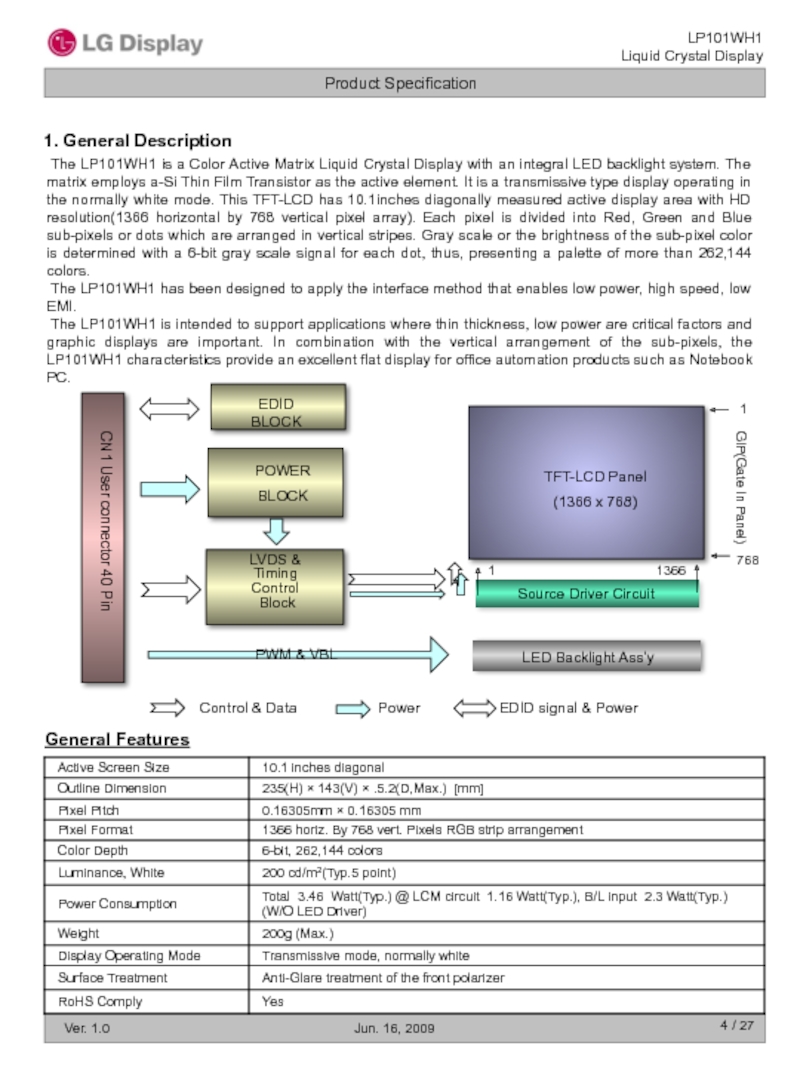
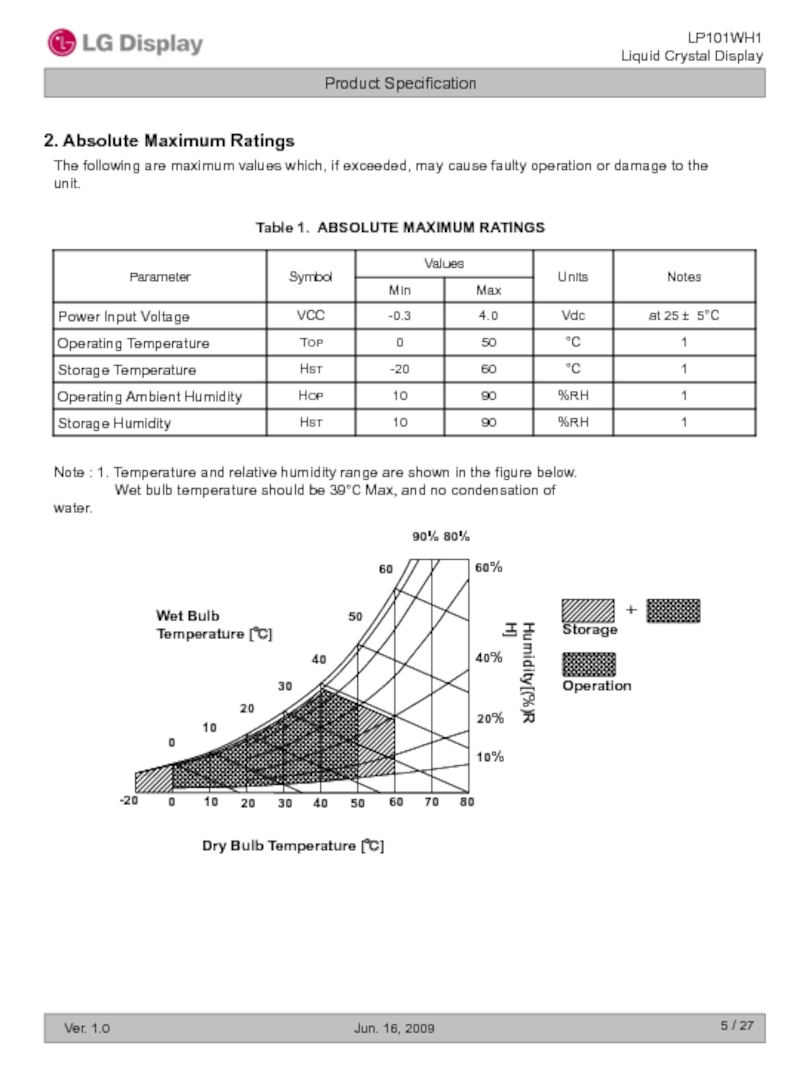
Table 1. ABSOLUTE MAXIMUM RATINGS
Note : 1. Temperature and relative humidity range are shown in the figure below.
Wet bulb temperature should be 39°C Max, and no condensation of water.
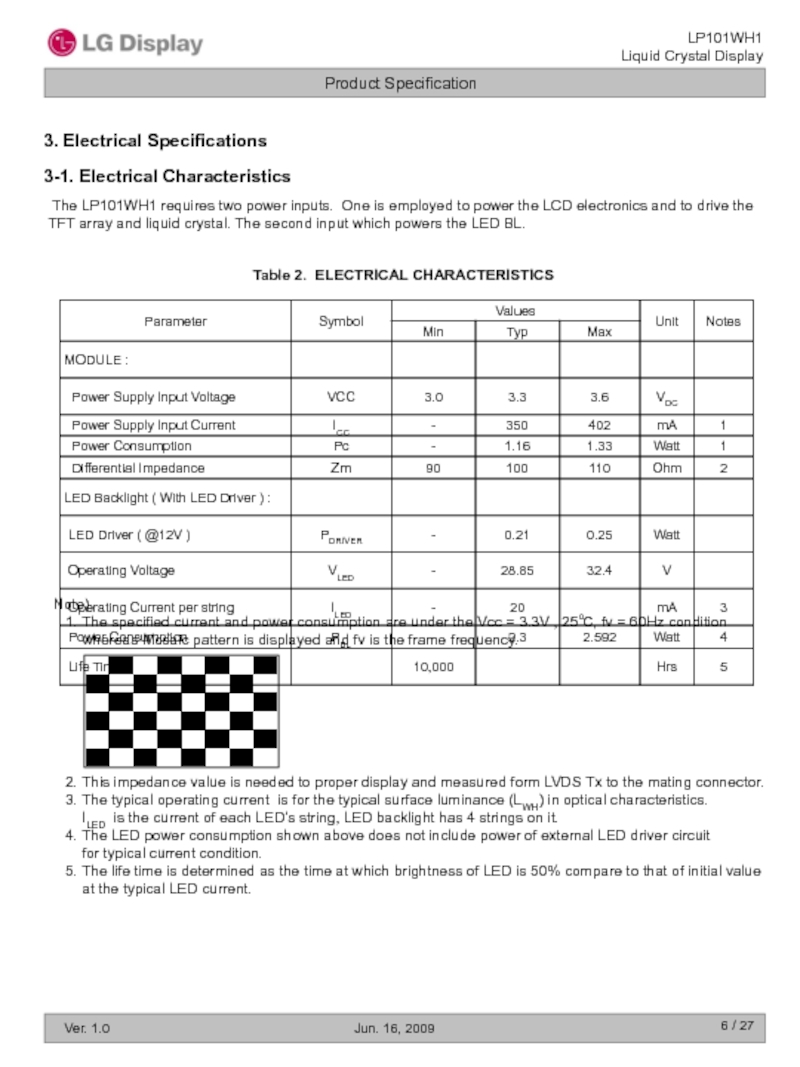
The LP101WH1 requires two power inputs. One is employed to power the LCD electronics and to drive the TFT array and liquid crystal. The second input which powers the LED BL.
1, Interface chips
1.1 LCD : SiW, 1port including
LVDS Receiver
1.2 System :
* Pin to Pin compatible with LVDS
2. Connector
2.1 LCD :I-PEX 20455-040E-0*
(Locking type)
or equivalent
2.2 Mating :
2.3 Connector pin arrangement
1
40
[LCD Module Rear View]
[Note 1]
On: 2.0V↑,Off:0~0.4V

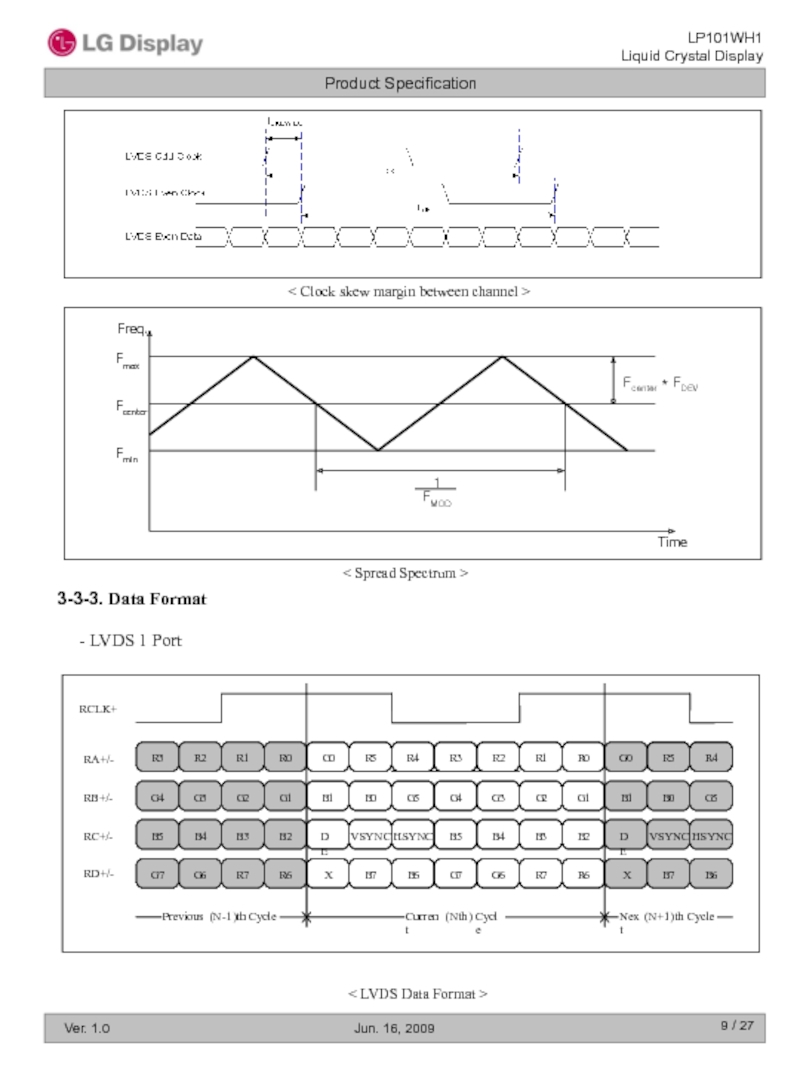
3-3-3. Data Format
- LVDS 1 Port
< Spread Spectrum >
G
0
R
5
R
4
R
3
R
2
R
1
R
0
B
1
B
0
G
5
G
4
G
3
G
2
G
1
DE
VSYNC
HSYNC
B
5
B
4
B
3
B
2
X
B
7
B
6
G
7
G
6
R
7
R
6
R
1
R
0
G
2
G
1
B
3
B
2
R
7
R
6
G
0
B
1
DE
X
Current
(
Nth
)
Cycle
R
5
R
4
B
0
G
5
VSYNC
HSYNC
B
7
B
6
R
3
R
2
G
4
G
3
B
5
B
4
G
7
G
6
Previous
(
N
-
1
)
th Cycle
Next
(
N
+
1
)
th Cycle
RCLK+
RA+/-
RB+/-
RC+/-
RD+/-
3-5. Signal Timing Waveforms

Table 7. COLOR DATA REFERENCE

Table 7. POWER SEQUENCE TABLE
T6
Interface Signal,
Vi
(LVDS Signal of Transmitter)
LED Power
(VLED,BL_ON,S_PWMIN Signal
:Refer to Table 3.)
Power Supply For LCD
(VCC)
90%
10%
10%
0V
90%
T1
T2
T5
Valid Data
0V
OFF
OFF
LED ON
T7
T3
T4
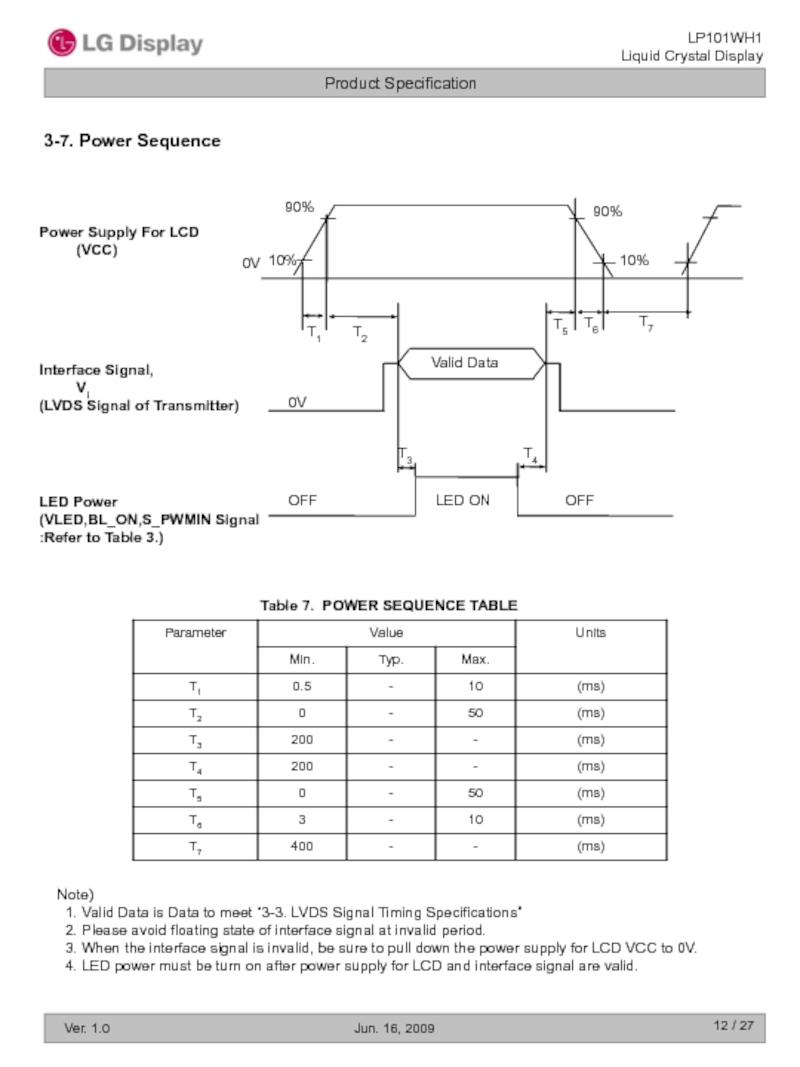
Table 8. OPTICAL CHARACTERISTICS
Ta=25°C, VCC=3.3V, fV=60Hz, fCLK= 72.3MHz, IBL= 20 mA
LCD Module
Optical Stage(x,y)
Pritchard 880 or
equivalent
50cm
Optical characteristics are determined after the unit has been ‘ON’ and stable for approximately 30 minutes in a dark environment at 25°C. The values specified are at an approximate distance 50cm from the LCD surface
at a viewing angle of Φ and Θ equal to 0°.
FIG. 1 presents additional information concerning the measurement equipment and method.

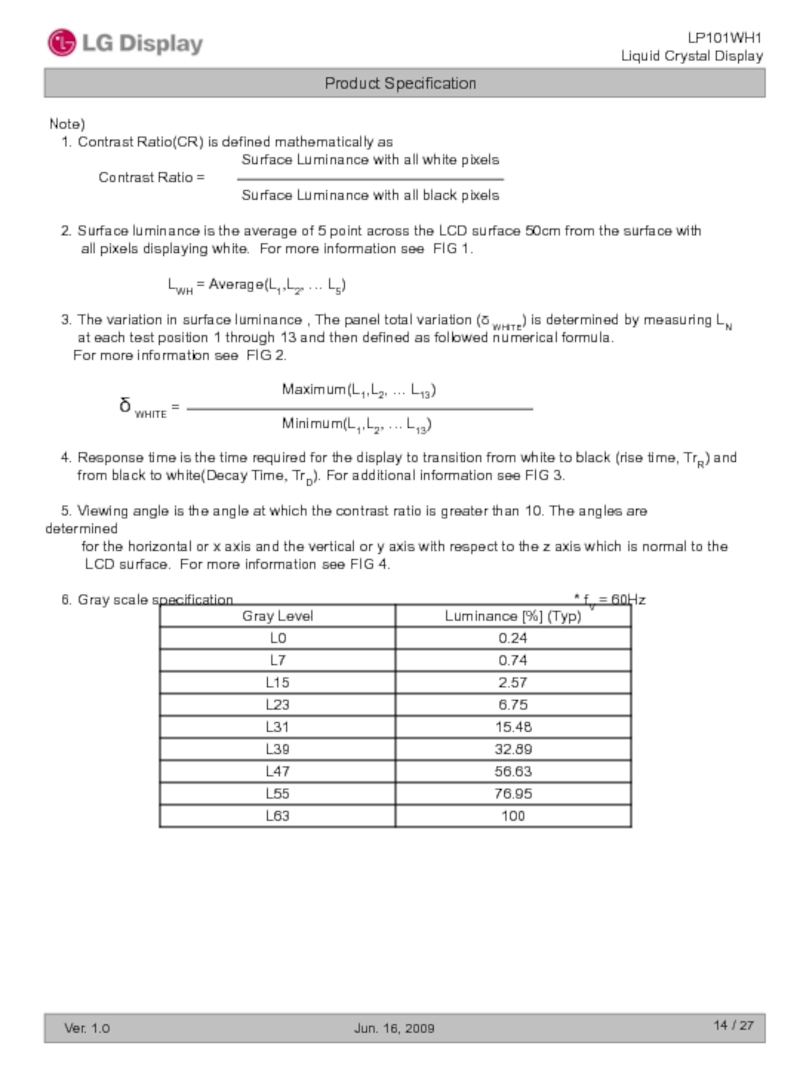
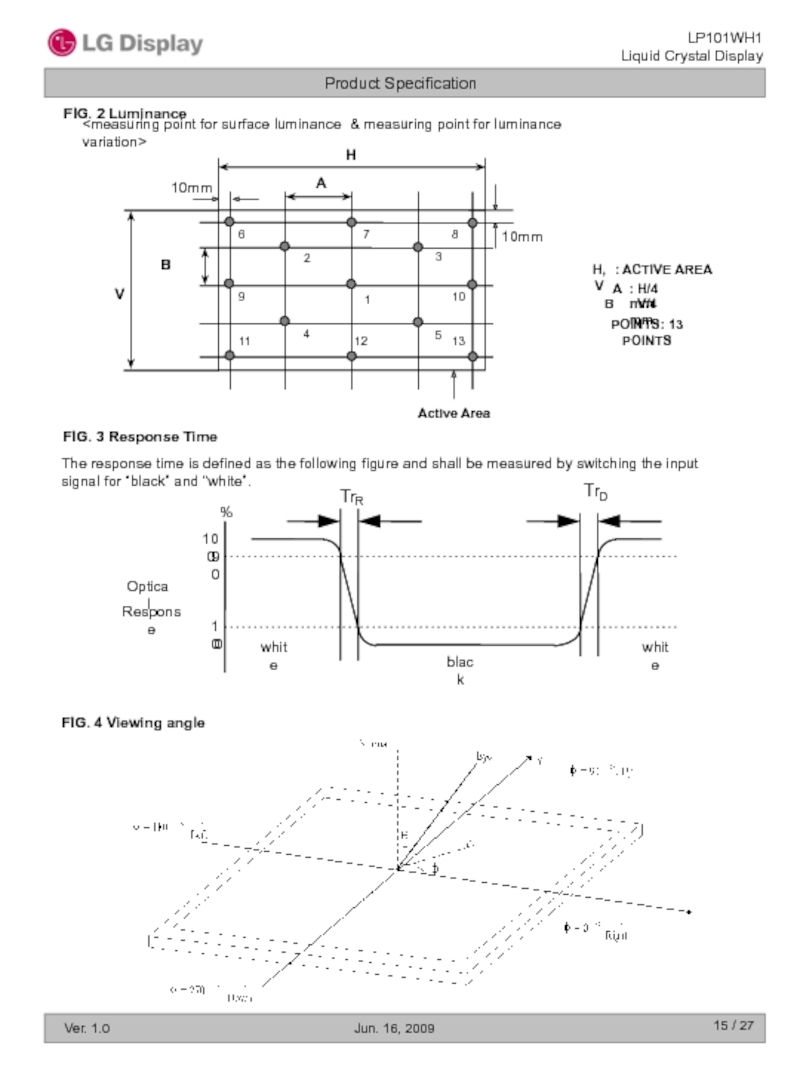
FIG. 2 Luminance
FIG. 4 Viewing angle
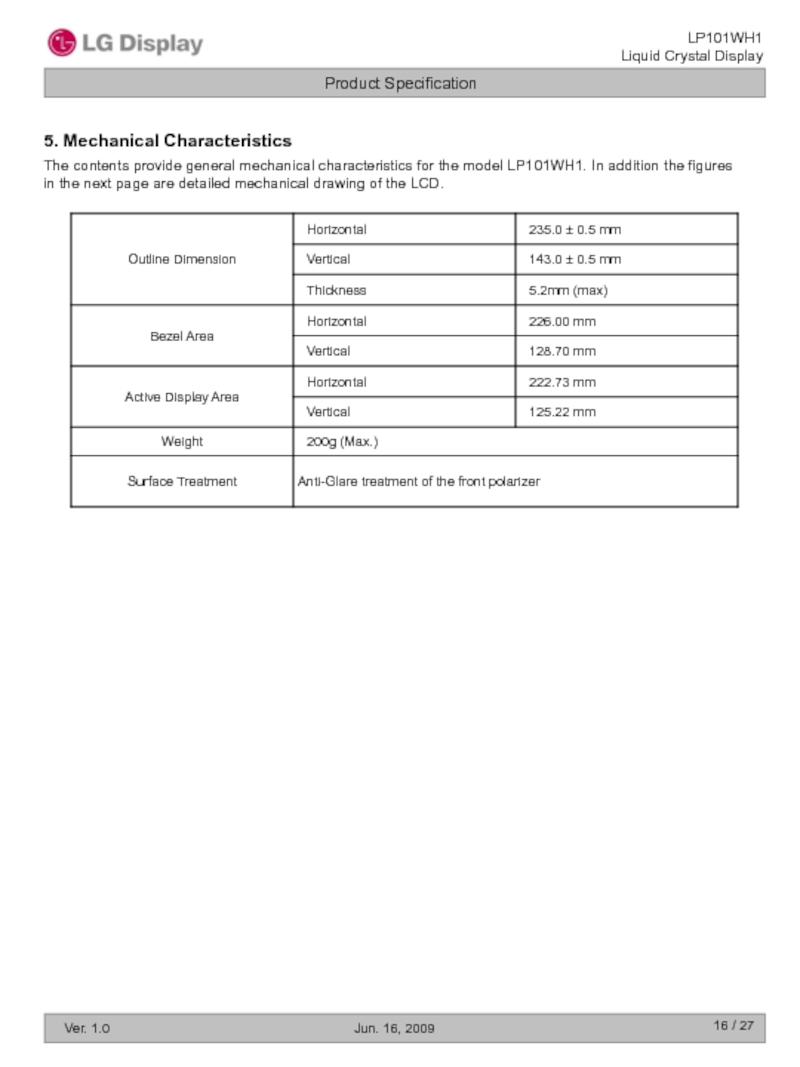
Section A-A
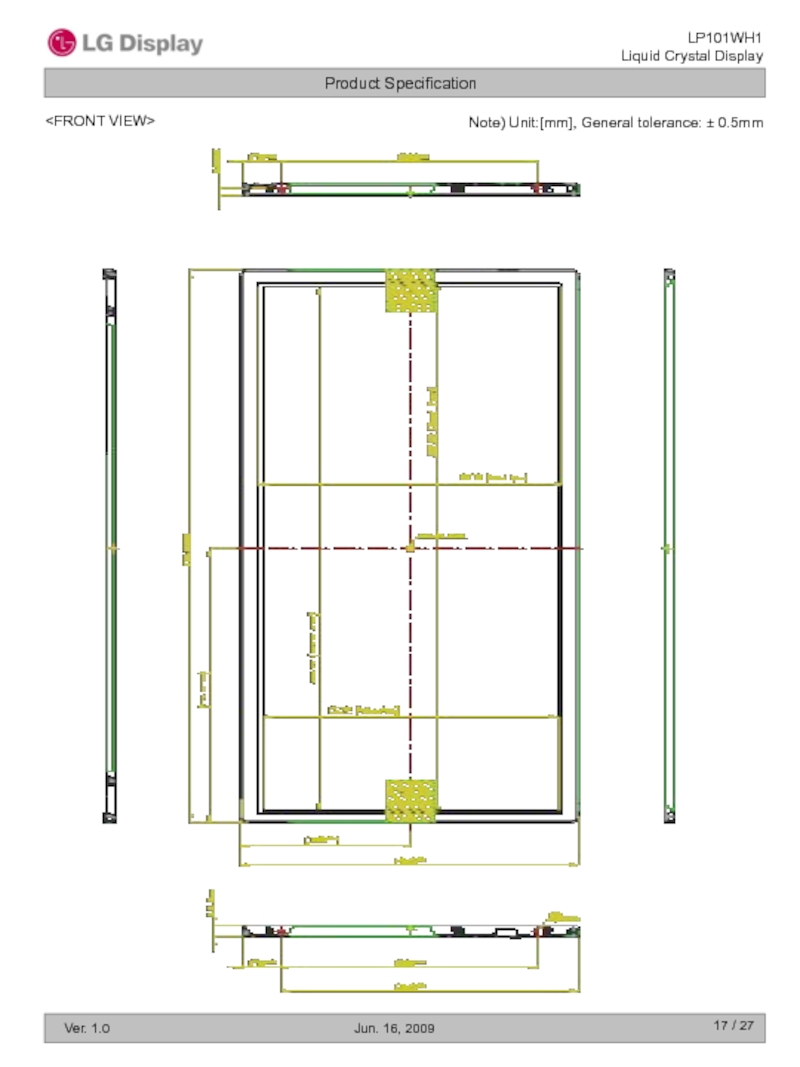
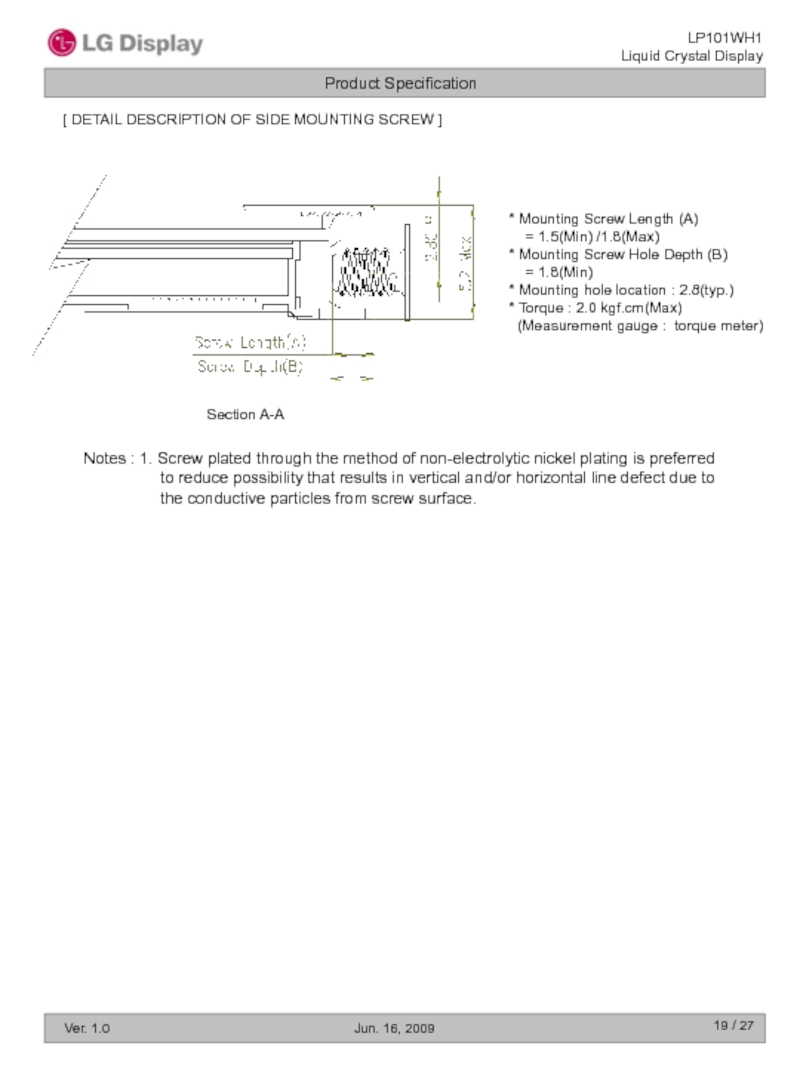
[ DETAIL DESCRIPTION OF SIDE MOUNTING SCREW ]
Notes : 1. Screw plated through the method of non-electrolytic nickel plating is preferred
to reduce possibility that results in vertical and/or horizontal line defect due to
the conductive particles from screw surface.
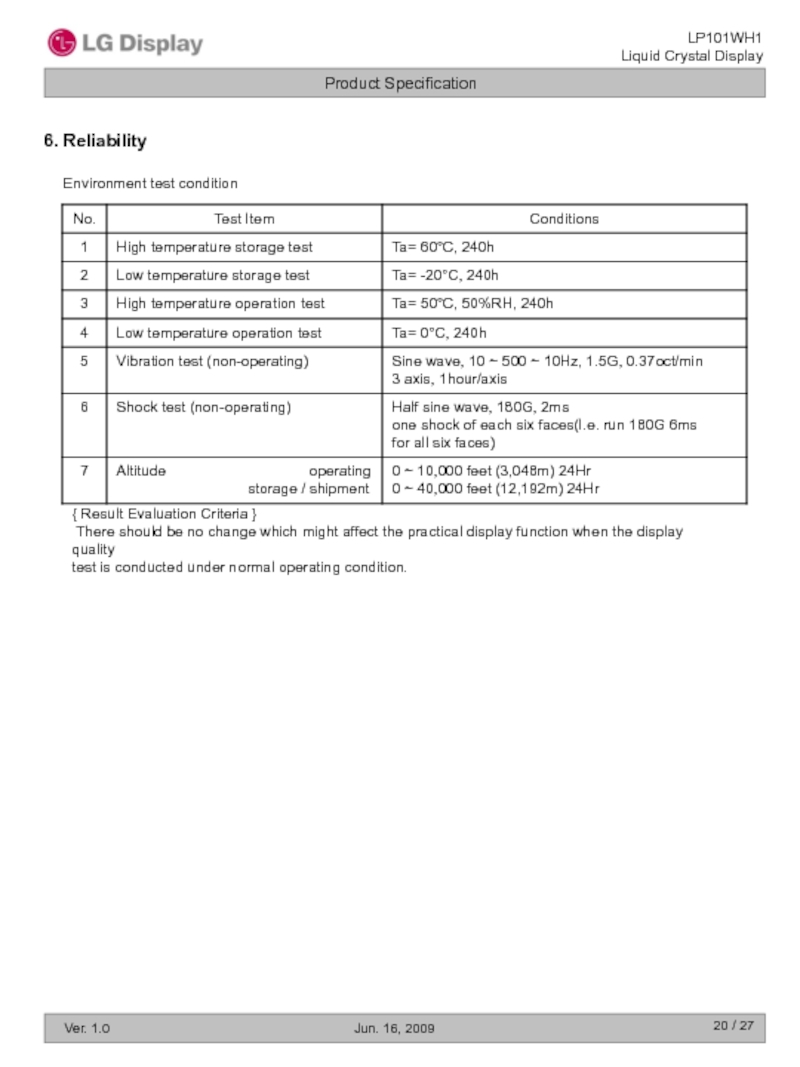
a) UL 60950-1:2003, First Edition, Underwriters Laboratories, Inc.,
Standard for Safety of Information Technology Equipment.
b) CAN/CSA C22.2, No. 60950-1-03 1st Ed. April 1, 2003, Canadian Standards Association,
Standard for Safety of Information Technology Equipment.
c) EN 60950-1:2001, First Edition,
European Committee for Electrotechnical Standardization(CENELEC)
European Standard for Safety of Information Technology Equipment.
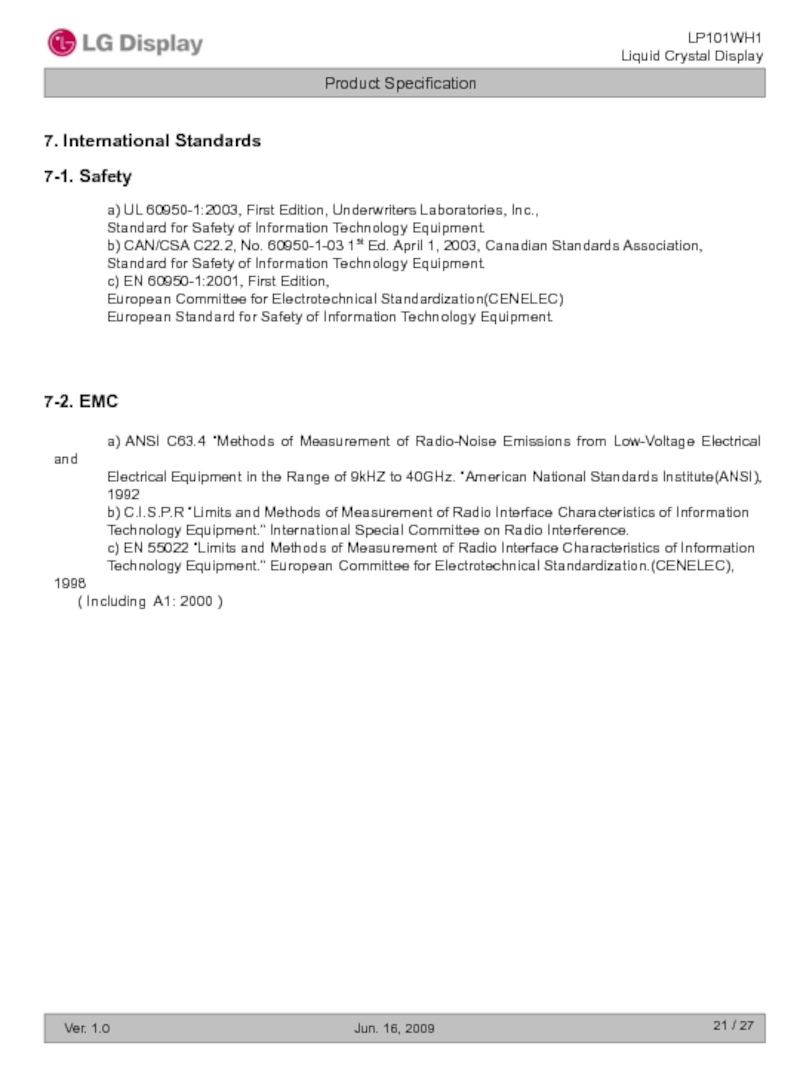
Note
1. YEAR
2. MONTH
b) Location of Lot Mark
Serial No. is printed on the label. The label is attached to the backside of the LCD module.
This is subject to change without prior notice.
8-2. Packing Form
a) Package quantity in one box : 40 pcs
b) Box Size : 395mm × 390mm × 309mm
9-1. MOUNTING PRECAUTIONS
(1) You must mount a module using holes arranged in four corners or four sides.
(2) You should consider the mounting structure so that uneven force (ex. Twisted stress) is not applied to the
module. And the case on which a module is mounted should have sufficient strength so that external
force is not transmitted directly to the module.
(3) Please attach the surface transparent protective plate to the surface in order to protect the polarizer.
Transparent protective plate should have sufficient strength in order to the resist external force.
(4) You should adopt radiation structure to satisfy the temperature specification.
(5) Acetic acid type and chlorine type materials for the cover case are not desirable because the former
generates corrosive gas of attacking the polarizer at high temperature and the latter causes circuit break
by electro-chemical reaction.
(6) Do not touch, push or rub the exposed polarizers with glass, tweezers or anything harder than HB
pencil lead. And please do not rub with dust clothes with chemical treatment.
Do not touch the surface of polarizer for bare hand or greasy cloth.(Some cosmetics are detrimental
to the polarizer.)
(7) When the surface becomes dusty, please wipe gently with absorbent cotton or other soft materials like
chamois soaks with petroleum benzene. Normal-hexane is recommended for cleaning the adhesives
used to attach front / rear polarizers. Do not use acetone, toluene and alcohol because they cause
chemical damage to the polarizer.
(8) Wipe off saliva or water drops as soon as possible. Their long time contact with polarizer causes
deformations and color fading.
(9) Do not open the case because inside circuits do not have sufficient strength.
9-2. OPERATING PRECAUTIONS
(1) The spike noise causes the mis-operation of circuits. It should be lower than following voltage :
V=± 200mV(Over and under shoot voltage)
(2) Response time depends on the temperature.(In lower temperature, it becomes longer.)
(3) Brightness depends on the temperature. (In lower temperature, it becomes lower.)
And in lower temperature, response time(required time that brightness is stable after turned on) becomes
longer.
(4) Be careful for condensation at sudden temperature change. Condensation makes damage to polarizer or
electrical contacted parts. And after fading condensation, smear or spot will occur.
(5) When fixed patterns are displayed for a long time, remnant image is likely to occur.
(6) Module has high frequency circuits. Sufficient suppression to the electromagnetic interference shall be
done by system manufacturers. Grounding and shielding methods may be important to minimized the
interference.

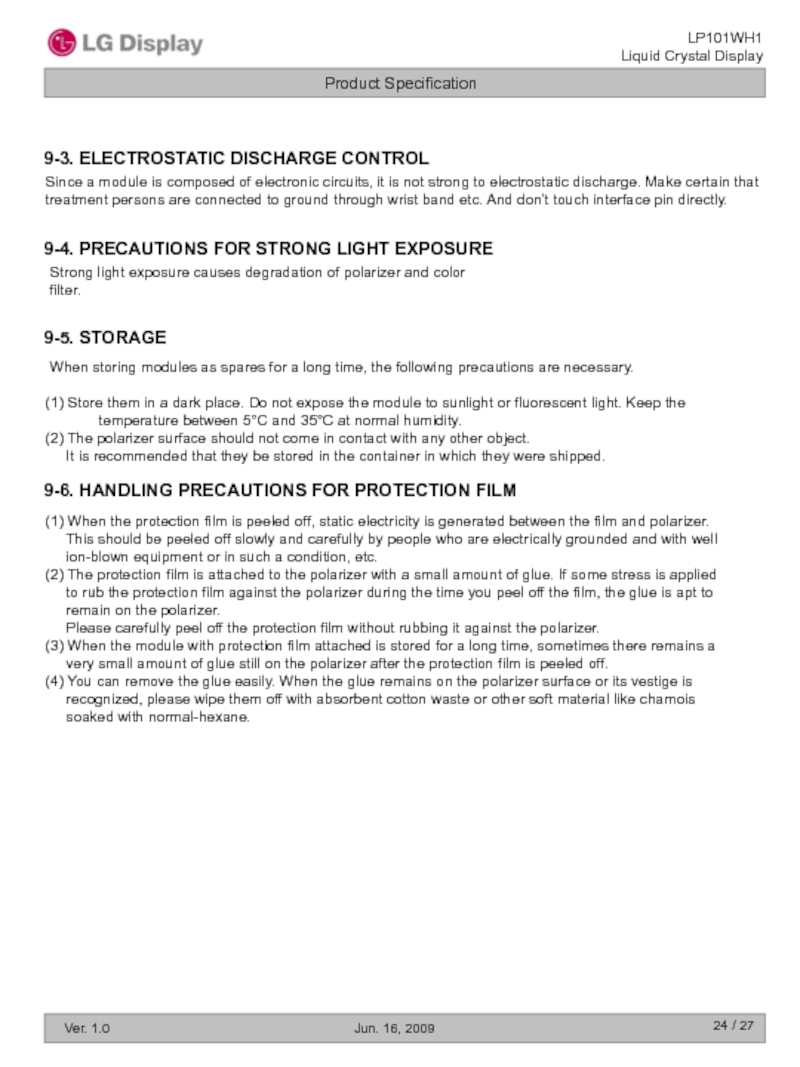
9-3. ELECTROSTATIC DISCHARGE CONTROL
Strong light exposure causes degradation of polarizer and color filter.
9-4. PRECAUTIONS FOR STRONG LIGHT EXPOSURE
9-5. STORAGE
(1) When the protection film is peeled off, static electricity is generated between the film and polarizer.
This should be peeled off slowly and carefully by people who are electrically grounded and with well
ion-blown equipment or in such a condition, etc.
(2) The protection film is attached to the polarizer with a small amount of glue. If some stress is applied
to rub the protection film against the polarizer during the time you peel off the film, the glue is apt to
remain on the polarizer.
Please carefully peel off the protection film without rubbing it against the polarizer.
(3) When the module with protection film attached is stored for a long time, sometimes there remains a
very small amount of glue still on the polarizer after the protection film is peeled off.
(4) You can remove the glue easily. When the glue remains on the polarizer surface or its vestige is
recognized, please wipe them off with absorbent cotton waste or other soft material like chamois
soaked with normal-hexane.
9-6. HANDLING PRECAUTIONS FOR PROTECTION FILM
When storing modules as spares for a long time, the following precautions are necessary.
(1) Store them in a dark place. Do not expose the module to sunlight or fluorescent light. Keep the
temperature between 5°C and 35°C at normal humidity.
(2) The polarizer surface should not come in contact with any other object.
It is recommended that they be stored in the container in which they were shipped.
Если не удалось найти и скачать презентацию, Вы можете заказать его на нашем сайте. Мы постараемся найти нужный Вам материал и отправим по электронной почте. Не стесняйтесь обращаться к нам, если у вас возникли вопросы или пожелания:
Email: Нажмите что бы посмотреть
Это сайт презентаций, докладов, проектов, шаблонов в формате PowerPoint. Мы помогаем школьникам, студентам, учителям, преподавателям хранить и обмениваться учебными материалами с другими пользователями.